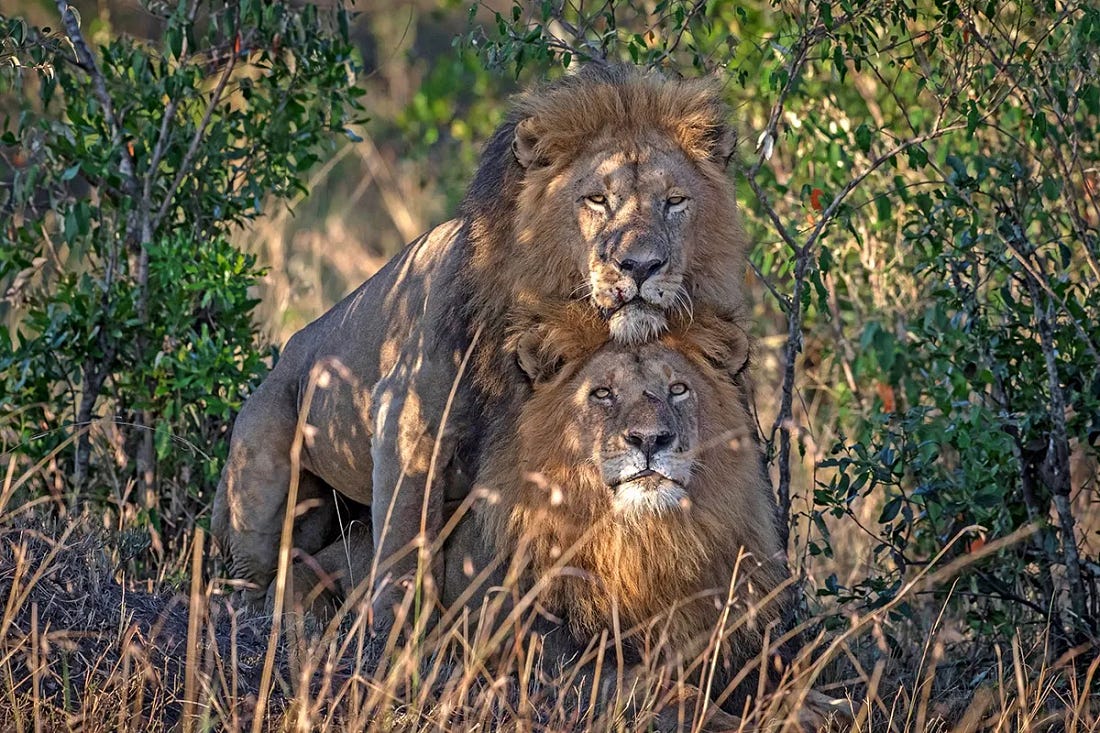
As I was doomscrolling this week (an activity I’ve promised my husband and my therapist that I would stop), I came across a story/meme that made me laugh out loud. I was excited to share it with you until I realized it was from 2017. That’s about three or four lifetimes ago by my post-pandemic-Trump-was-voted-out-but-now-he’s-back era math. Sex on Wednesday is usually about current events (I’m really into current events), so I kept scrolling. Then I decided that current events aren’t making me laugh out loud and reasoned that there were Wednesdays eight years ago. So, I made the executive decision to launch “Way Back Wednesday” and talk about gay lions. A photograph taken that year featuring a male lion in Kenya’s Masai Mara National Reserve humping another male went viral, and government officials were not amused. The head of the Kenya Film Classification Board blamed humans for the animals’ behavior. He told Nairobi News, “Probably, they have been influenced by gays who have gone to the national parks and behaved badly.”
Blaming gay people for boy-on-boy animal sex takes homophobia to a new level, and it’s just wrong. As we’ve discussed before, same-sex sexual behavior is common in the wild. According to a 2023 study published in Nature Communication, it’s been observed in over 1,500 animal species. Our ape ancestors are all for it; bonobos boff anyone, and female macaques form long-term sexual relationships with each other. Dolphins stick their bottle noses wherever they want on whomever they want. And swans—who are known to mate for the long term—sometimes do so with a swan of the same sex. This is especially true of male Australian black swans. It happens in captivity too. There were the gay penguins at the Central Park Zoo who were featured in the much-banned book And Tango Makes Three. (Sadly, they have since broken up. One of them immediately found a female partner, but the other was quite devastated.) I also remember writing about two male brown bears in captivity who were seen having oral sex on multiple occasions. (My efforts to find the original article by searching for “gay bears oral sex” were not particularly efficient for obvious reasons.) We think of animals as dominated entirely by evolutionary goals and the need to reproduce, but it seems possible that they sometimes have sex for the same non-conception reasons we do—it feels good. In the case of the Kenyan lions, however, experts think that what was caught on film wasn’t actually sexual behavior at all. Craig Packer, founder of the Lion Research Center at the University of Minnesota, told Live Science at the time that the lions were engaging in social—not sexual—bonding. Apparently, male lions follow a particular script when there’s a fertile female involved. They guard her carefully (so no other male lions can get close), have sex every half hour for days, ejaculate almost immediately upon penetration, and let out a distinct yowl. (Do we suppose that’s lion for “Oh yeah, I hit that?”) None of these things happen when two male lions start humping. No ejaculation. No yowl of satisfaction. Male lions sometimes form a coalition (though it sounds more like a posse or a street gang). They work together in groups of two or three to drive off male rivals and take over prides of females. If they’re successful, they kill any babies fathered by the ousted males and get to work making their own. While these alpha males are dicks to other guys and their would-be step-kids, they are affectionate with each other. They lie on each other, lick each other, rub faces, and sometimes hump just for fun. That’s what was caught on camera and blamed on gay tourists in 2017. The official who objected to their behavior went on to suggest that the “demonic spirits inflicting in humans seem to have now caught up with animals.” To be clear, this level of homophobia makes me sad and angry. It is not why I laughed out loud. What cracked me up so much that I decided to invent “Way Back Wednesday” was an accompanying tweet (it was still Twitter in 2017) that said something to the effect of, “I want to meet the gay guys who were willing to f**k in front of lions.” So do I, random dude on the internet 8 years ago, so do I. A More Dangerous Version of Mpox Has Spread in CaliforniaI could make a cheesy transition from lions to monkeys, but I’m better than that. Besides, the World Health Organization told us years ago to drop the monkey part because it was misleading and stigmatizing. (Interestingly, the CDC seems to have gone back to using monkeypox. I don’t know when that reverted, but the current administration has asked the agency to use a lot of other stigmatizing language, so this could very well be part of its absurd attack on all things “woke.”) Whatever we’re calling it, there’s a more serious version of this virus that appears to have spread to three people in California. While nobody expects this to be the same widespread outbreak we saw a few years ago, experts are concerned about local spread, especially now with the government shutdown and the gutting of our public health infrastructure. (Do we even track viruses anymore?) To refresh our memory (because 2022 was also a few lifetimes ago), mpox is a smallpox relative that has been endemic to Africa for decades. In 2022, the virus spread rapidly around the world in an outbreak that infected 114,000 and caused 220 death globally. In the United States, the outbreak peaked that summer withe over 450 cases a day or 11,000 each month. There two types of the mpox virus. That outbreak was caused by a clade II type of the virus which was spread primarily through sexual behavior among men who have sex with men. Clade II mpox is less serious. It typically causes mild symptoms and has a 1% mortality rate. Clade I mpox, on the other hand, has a 10% mortality rate. This type of the virus has been endemic to the Democratic Republic of the Congo (DRC) for many years, but it didn’t used to spread from person to person. Clade I viruses have historically only been found in people who butchered or ate infected animals. A new outbreak that began in the DRC in 2023 has been spreading from person to person in that country and beyond. In some places in Africa, this clade I virus is being spread between family members through daily household activities. It is also being spread in patient care settings when appropriate protective gear is not available. In these areas, many cases have been reported in children under the age of 15. In other areas, sexual transmission is more common. This is the first time that clade I mpox has been sexually transmitted. Most cases are being passed through heterosexual sex, often among sex workers, truck drivers, and other transient workers. There have been more than 40,000 cases of clade I mpox in several countries in Central and Eastern Africa. There have also been cases in other countries, but most have been in people who had recently traveled to Africa. Until now, there had been only six reported cases of clade I mpox in the United States. All of them had been in people who had recently traveled, but the three new cases in California—one in Long Beach and two in Los Angeles County—are in people who have stayed put. Public health officials have also not been able to find a direct link between them. This suggests that the clade I mpox is spreading locally. Officials are working to identify potential sources of transmission. They’re also trying to understand how serious this type of the virus may become here. All three infected individuals did have to be hospitalized, but they have all since recovered. It is possible that access to better health care will mean better outcomes for cases in this country than those in other parts of the world. When I say public health officials in this context, I specifically mean California officials. It’s unclear what, if any help, they’re getting from the CDC. One news outlet noted that the CDC press office did not comment and told them to contact state officials. Not a surprising response for an agency that has been eviscerated, politicized, and now furloughed, but it should scare us all. It seems unlikely that clade I monkeypox will spread rapidly through the U.S., but it would be nice to think somebody was keeping an eye on it at the national level. In 2022, the U.S. was able to quell the mpox outbreak relatively quickly through tracking, clear public health messaging, and scrambling to vaccinate people at risk. It’s hard to imagine RFK Jr’s HHS doing any of that even when (if?) the government shutdown ends. California officials, however, are reminding both providers and people at higher risk for mpox to stay vigilant. During the clade II outbreak, the CDC recommended the vaccine for gay, bisexual, transgender, and other men who have sex with men who have recently had (in the last six months) or plan to have:
Anyone who fits these criteria and hasn’t gotten the JYNNEOS vaccine yet, should definitely do so. Last time around, the CDC put out mpox-specific safer sex guidelines, which remind people that the virus spreads through close face-to-face contact as well as contact with blisters and any fabric that has touched the blisters. During the 2022 outbreak many MSM changed some of their behaviors. They reduced anonymous sex, had less skin-to-skin contact, and washed all bedding immediately. These, and other changes, were credited with keeping infections lower.
Of course, we don’t yet know how this is spreading in the U.S. or among whom. The risk of a new clade I mpox epidemic in this country seems pretty low, but the idea of any epidemic hitting while these clowns are driving the public health bus is terrifying. Escaped Monkeys Don’t Have Hepatitis, Herpes, or Covid, Really They Don’tIn a scene that could have been straight out of Outbreak 3: The Virus Takes Tupelo, a truck carrying an unspecified number of rhesus monkeys crashed about 100 miles from the Mississippi’s state capitol. It’s not yet clear what caused the crash. (In the movie it would either be an act of terrorism or a stoned driver who wasn’t taking his job seriously.) What we do know is that many of the monkeys escaped their crates and fled into the surrounding communities. The monkeys were traveling from a research lab at Tulane University. Initial reports suggested that they were infected with hepatitis C, herpes, and COVID-19. The local sheriff’s office posted a warning to residents that the animals were approximately 40 pounds, disease-ridden, and aggressive to humans. (Unless this sequel includes monkeys who were hit with Hulk-style gamma rays, that weight seems off. Rhesus monkeys are typically about 16 pounds.) Tulane quickly put out a statement saying that the animals in question were “not infectious” (which in the movie is code for “holy f**k what have we done?”). The real story is still unfolding as of this morning, but it does not have a happy ending. As of now, all but three of the monkeys have been found and killed. (The movie’s story, on the other hand, has become totally clear. Our hero hotheaded primatologist who knows everything but is never listened to now needs to work closely with his ex-wife who is second in command at a secret government laboratory to track down these three monkeys before they infect any humans with an experimental virus that is being developed as a cure for Alzheimer’s or maybe a biochemical weapon while also convincing the powers that be that destroying the animals will set scientific advancements back by decades and that he —and only he—can get them back unharmed and save the city.) Sex on Wednesday is free today. But if you enjoyed this post, you can tell Sex on Wednesday that their writing is valuable by pledging a future subscription. You won't be charged unless they enable payments.
|
Who Taught The Lions How to F**k?







0 comments:
Post a Comment