| This Human Rights Day, SRHM calls attention to the right to science as a fundamental pillar for the fulfilment of sexual and reproductive health and rights.
Enshrined in the International Covenant on Economic, Social and Cultural Rights (Article 15), the right to enjoy the benefits of scientific progress and its applications affirms that everyone is entitled to participate in scientific life, access trustworthy knowledge, and benefit from advances that support wellbeing and autonomy.
In a moment when ideology-driven laws and narratives increasingly override evidence, this right is both essential and under pressure. Upholding it is not only about countering misinformation and disinformation, it is about ensuring that evidence and rights-based knowledge guide the policies, services, and decisions that shape people's bodily autonomy and wellbeing.
As science continually evolves, so does our collective responsibility to protect its integrity, expand equitable access, and ensure it strengthens SRHR for all.
This newsletter brings together SRHM resources that illuminate the meaning of this commitment and the diverse ways it is understood and championed across our global community. | | | | The Right to Science:
When Embryo Personhood Laws Clash with Evidence
In its latest issue, the SRHM Journal published "The right to science in sexual and reproductive health and the legal status of the human embryo", an article written by Silke Dyer, Alison Edelman, Joanna Erdman and Asha George, which argues that the right to enjoy the benefits of scientific progress and its applications must guide any legal or policy decisions about embryos.
Granting embryos legal "personhood", often rooted in ideology rather than scientific evidence, risks undermining access to essential sexual and reproductive health services, including assisted reproduction, contraception, and abortion care, and threatens the integrity of SRHR.
To bring this argument into sharper focus, the new SRHM Podcast episode features Silke Dyer, Alison Edelman, Joanna Erdman, Asha George, joined by the SRHM Chief Executive Eszter Kismődi.
They discuss how ideology-driven personhood laws can override scientific consensus, distort public policy, and erode reproductive rights worldwide.
Together, the article and podcast remind us that science, and respect for the right to scientific knowledge, must remain at the heart of laws and policies affecting sexual and reproductive health and rights.
| | | SRHM is also actively strengthening efforts to counter misinformation and disinformation, working in close partnership with diverse actors across the SRHR ecosystem, including the communities whose rights are most affected.
Through collaborative evidence generation, rights-based analysis, and accessible communication, SRHM and its partners help clarify complex issues, challenge inaccurate or ideologically driven narratives, and support communities, advocates, and policymakers in navigating today's contested information landscape.
By sharing trusted knowledge, amplifying expert and community voices, and promoting transparent, inclusive dialogue, SRHM contributes to a collective foundation of informed decision-making and public trust.
Together with our partners and the communities we serve, we ensure that accurate, rights-based information remains a powerful force for advancing SRHR globally. | | The (mis)use of evidence in contested rights | | | SRHM hosted a powerful webinar examining the (mis)use of evidence and rights standards in the UN Special Rapporteur's report on "prostitution and violence," highlighting how inaccuracies, misrepresented evidence, and the erasure of sex workers' voices undermine human rights and why accuracy and transparency are essential in contested legal and policy debates. | | | Surrogacy and bodily autonomy as a matter of sexual and reproductive justice
| | | This SRHM webinar and podcast explore how surrogacy, bodily autonomy, and the right to science shape sexual and reproductive justice. Together, they bring legal, scientific, and rights-based perspectives to some of the most contested questions in SRHR today. | | | Challenging non-US, school-based comprehensive sexuality education evidence base
| | | What do oral contraceptive pills have to do with human rights abuses in sport? | | SRHM's article and webinar " What do oral contraceptives have to do with human rights abuses in sports?" expose how sex-testing regulations in elite athletics rely on faulty scientific assumptions about oral contraceptives and disregard fundamental human rights and medical ethics. They offer a timely, evidence- and rights-based critique, in relation to the Caster Semenya's landmark hearing by the European Court of Human rigths, showing how coerced, medically unnecessary interventions violate athletes' bodily autonomy and undermine justice in sport. | | | SRHM continues to champion the principle that how we create knowledge matters just as much as what that knowledge says.
Rights-based knowledge creation affirms that evidence is most meaningful when it is generated through processes grounded in participation, equity, transparency, and accountability.
It elevates the voices and experiences of communities, safeguards autonomy and dignity, and strengthens the quality and relevance of the knowledge produced.
By advancing inclusive and ethical approaches to research,
SRHM supports evidence that reinforces human rights, informs policy, and empowers communities. This work contributes to a resilient SRHR knowledge ecosystem that drives effective and just action. | | | Rights-based knowledge creation in SRHR:
An introductory guide
| | | SRHM's Rights-Based Knowledge Creation in Sexual and Reproductive Health and Rights guide provides a practical, step-by-step framework for generating, interpreting, and using knowledge in ways that uphold human rights and centre the communities most affected.
Far beyond outlining a vision, it offers concrete guidance for researchers, practitioners, and advocates on how to embed participation, equity, transparency, and accountability throughout the entire knowledge process, ensuring that SRHR evidence genuinely strengthens justice and meaningful change. | | | Podcast on key concepts of rights-based knowledge creation
| | | This SRHM podcast episode on rights-based SRHR research explores practical, human rights–grounded approaches to conducting ethical, inclusive, and community-centred research in sexual and reproductive health and rights. | | | Podcast and roundtable discussion on rights- and evidence-based knowledge in legal action | | | This episode, based on a round-table discussion by SRHM, explores how rights-based and evidence-based knowledge can be strategically applied in legal and human-rights action around sexual and reproductive health.
Experts from different regions reflect on what constitutes valid evidence today, how rights-based knowledge evolves in changing contexts, and how these can be harnessed in advocacy, legal challenges, and effective SRHR policymaking. | | HIGHLIGHTED PAPES FROM THE SRHM JOURNAL The right to science in sexual and reproductive health and the legal status of the human embryo Silke Dyer, Alison B. Edelman, Asha S. George, Tari Turner & Joanna N. Erdman The sex effect: the prevalence of sex life reasons for contraceptive discontinuation. A systematic review and meta-analysis Mirela Zaneva, Nandita Thatte, Anne Philpott, Clara Maliwa, Rhiana Mills & Lianne Gonsalves Avortement au Maroc et virage au drame : femmes et professionnels de santé en parlent ! Une étude transversale mixte à Agadir Sanae Elomrani, Bettina Utz, Vincent De Brouwere, Imane Kajjoune & Bouchra Assarag Lessons from Kenya on sexual reproductive health and rights policy-making: the need to centre voices from Africa in global discourses Evelyne Opondo, Jade Maina & Nelly Munyasia
Editorial: The continuing fight for abortion rights: taking stock of the evidence Eszter Kismödi, Emma Pitchforth, TK Sundari Ravindran, Laura Ferguson, Mindy Jane Roseman, Jane Cottingham & Sapna Desai The (mis)use of evidence in contested rights: commentary on the UN Special Rapporteur on violence against women and girls' report on "prostitution and violence" Susana T Fried, Alice M Miller, Rupsa Mallik, Ivana Radačić & Esteban Restrepo-Saldarriaga
Editorial: Sexual and reproductive health and rights in Palestine – securing spaces to speak out Laura Ferguson & Sapna Desai No justice in a genocide: sexual and reproductive health and rights in Gaza Cordelia Freeman & Hala Shoman Beyond reproductive rights: implementing the Africentric reproductive justice framework in sexual and reproductive health and rights litigations in Africa Moses Mulumba, Jessica Oga & Nimrod Muhumuza The limits of preconception care for global health Miranda R. Waggoner & Michelle Pentecost | | | | SRHM connects rights- and evidence-based knowledge directly to politics and action, transforming research into tools that shape policy, challenge harmful ideologies, and advance justice.
From landmark analyses such as The Global Impact of the Trump Administration's Executive Orders on SRHR, to the Gender and Sexuality Research Declaration, to critical examinations of criminalisation politics in Female Genital Mutilation in Africa, and Allan Maleche's powerful podcast on rights-based legal action in Kenya, SRHM's work actively informs political debates and strengthens movements working for equitable SRHR worldwide. | | A Landmark Win for Reproductive Rights:
Kenya's High Court Ruling on the National Reproductive Health Policy | | | In this SRHM Podcast episode, Eszter Kismodi speaks with Allan Maleche and Jerop Limo about the groundbreaking High Court of Kenya case challenging the National Reproductive Health Policy (2022–2032) as discriminatory and unconstitutional, exploring how the partial yet significant ruling advances reproductive rights, reinforces the Maputo Protocol and Kenya's Constitution, and energises youth- and civil society–led advocacy for rights-based SRHR policy and accountability. | | The Global impact of the trump administration's Executive Orders on SRHR
| | | SRHM hosted an insightful webinar which brought together global experts to discuss the far-reaching consequences of the Trump Administration's Executive Orders on SRHR. The discussion highlighted the devastating impact of funding freezes, restrictive policies, and ideological attacks on sexual and reproductive healthcare, LGBTQ+ rights, and global health programmes. | | Statement on the Importance of Sexuality and Gender Research
| | | SRHM has signed on to a statement by a number of academic journals in the field of sexuality, sexual health and rights and gender, which responds to the call for U.S. government researchers to withdraw all research manuscripts which are being considered for publication by external scientific journals which contain terms, such as gender, transgender, LGBT (lesbian, gay, bisexual and transgender) and nonbinary so that they can be reviewed.
It is the view of this statement, and SRHM, that these efforts constitute clear examples of censorship of science and thus a political attempt to obstruct the discovery of knowledge. | | Female Genital Mutilation in Africa:
Politics of Criminalization
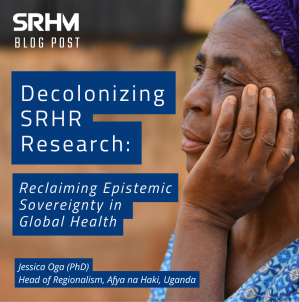
| | SRHM hosted a thought-provoking webinar to launch the open-access book Female Genital Mutilation in Africa: Politics of Criminalisation, edited by Satang Nabaneh. The event brought together contributing authors to reflect on the complex and evolving debates around FGM in Africa, particularly the role and limits of criminalization. | | | SRHM's blogs, from decolonizing SRHR research and reclaiming epistemic sovereignty to feminist critiques of anti-gender policies and the UK Supreme Court's ruling on who is a "woman", illuminate how power, knowledge, and rights collide in today's global debates. | | Decolonizing SRHR Research: Reclaiming Epistemic Sovereignty in Global Health
| | | SRHR research in African contexts continues to be shaped by ways of thinking and institutional practices inherited from the colonial era.
Although global health actors are expanding the vocabulary of participation, inclusion, and localization, the material structures and ideological assumptions that shape SRHR research, including what questions are asked, how evidence is defined, and whose voices count, often remain unchanged. | | Anti-gender policies do not protect us: Reflecting as feminists on the recent UK Supreme Court ruling on who is a "woman"
| | | A recent UK court decision is likely to reinforce harmful biological essentialist conceptions of "sex," and a limited understanding of "gender," both of which can be easily reinterpreted to work against gender justice – if the pretext of safeguarding groups based on their "sex" is translated into laws and policies that limit bodily autonomy in the name of protection. It can also be utilized to do harm through stigma and discrimination. | | In a world increasingly shaped by misinformation, ideological backlash, and political interference, protecting science, and ensuring its benefits reach all people, is both a human rights obligation and a collective act of resistance.
This Human Rights Day, SRHM reaffirms its commitment to defending the right to science as a cornerstone of sexual and reproductive health and rights.
SRHR cannot be realised without truth, and truth cannot be safeguarded without science.
SRHM will continue to stand at this vital intersection:
generating knowledge, challenging misinformation, and strengthening the evidence that advances justice, autonomy, and human dignity. | | | | |






0 comments:
Post a Comment