There seems to be a party line on Project 2025: “Trump has nothing to do with that.” That’s what he says. That’s what Fox News says. That’s what the Heritage Foundation says. That’s clearly what the Republicans would like their voters to believe. And that’s the message that has been parroted back to me in the handful of interactions I’ve had with Trump supporters in the last few weeks. Repetition, however, does not make it true. Okay, fine, Trump didn’t write it. And at 922 pages, I have no problem believing he hasn’t read it (he never read his daily briefing books when in office either). But whether he wrote it, read it, skimmed it, or keeps it as toilet paper next to his gold throne is irrelevant to the only important question: will he implement it? And the answer to that is a resounding yes. The people who did write it are his people. A CNN review found massive overlap between the Project 2025 authors/supporters and Trump’s orbit of advisors/supporters. Over 240 to be exact, though CNN points out there are likely more whose resumes were not publicly available. More than half of the people who are listed as authors, editors, and contributors to the official report, Mandate for Leadership, worked in Trump’s administration including six Cabinet Secretaries. Familiar names from Trump 1.0, like Mark Meadows and Stephen Miller (whom I refer to as Dead Eyes), now work with conservative groups that support Project 2025, as do the architects of his fake electors plan and the lawyers who defended him against impeachment. Trump’s ties to the Heritage Foundation are also undeniable. In 2018, the organization posted a genuflecting article with the headline “Trump Administration Embraces Heritage Foundation Policy Recommendations.” The article boasts that 70 former foundation employees were part of the Trump transition team and/or administration. In 2022, Trump posed for this picture with Heritage Foundation President Kevin Roberts, the primary author of the plan. The two were on a private plane heading to the foundation’s conference where Trump would say in his keynote speech: “They’re going to lay the groundwork and detail plans for exactly what our movement will do.” Of course, the future relationships with 2025 supporters are the most concerning. When asked about immigration on a California radio show last weekend, Trump said he was bringing back Tom Homan. As the Acting Head of ICE from 2017-2018, Homan is said to be the architect of Trump’s cruel child separation policy. He is also listed as an author on Project 2025. Speaking on a panel at the National Conservatism Conference in July, Homan said, “Trump comes back in January, I’ll be on his heels coming back, and I will run the biggest deportation force this country has ever seen. They ain’t seen s**t yet. Wait until 2025.” Historian Heather Cox Richardson noted recently that Trump is not putting together a transition team which most campaigns do close to election day in case they, you know, win. While it would be great to think they’re not bothering because they realize they can’t win, Richardson suggests the campaign may just be letting the Heritage Foundation do the work for them. After all, the ultimate goal of Project 2025 is to stack the government with loyalists at every level, and they’ve been getting their lists together for a while now. Trump can keep pretending that he has nothing to do with Project 2025, but if he’s elected, he will hire all of the people who did. That should—and does—scare most of us, and they know it. That’s why the answer to questions about the plan (whether asked by debate moderators or my 14-year-old daughter) is never “Yes, he’s behind Project 2025, isn’t that great!” Mainstream voters (even Republicans) were horrified by the family separation policy that kept kids in cages. They believe in science. They don’t want to see the Department of Education dismantled. They want access to abortion, contraception, and IVF. And they like porn. Defending the plan on the issues reminds people that a vote for Trump is a vote for regressive policies like this one on contraception that Lynn M. Paltrow and Jennifer Weis-Wolf point out in Ms. Apparently, as part of revamping the Department of Health and Human Services (HHS) in its own, anti-science image, Project 2025 says:
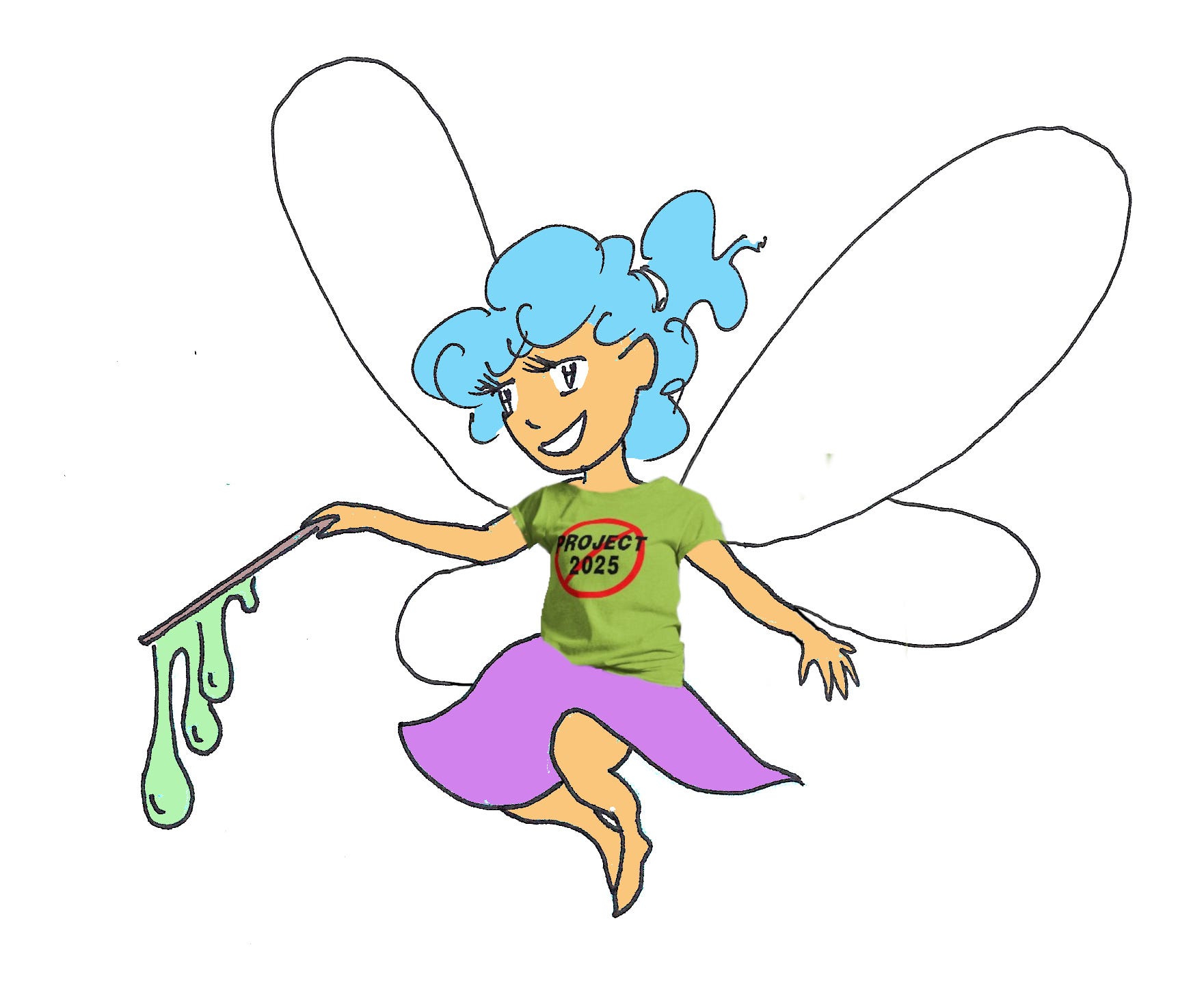
I like the idea that today’s sophisticated natural family methods—many of which are app-based and rely on algorithms to predict ovulation—are embarrassed to be associated with their provincial ancestors. There may be a little more science and a little less guesswork behind the modern versions, but suggesting they have “unsurpassed effectiveness” in a world that includes implants and IUDs is absurd. Whether you use an abacus, a calendar, or an iPhone app, this is a math-based method predicated on the idea that we’re really only fertile for a few days in any given menstrual cycle. Specifically, an egg is only viable for about 24 hours after ovulation, and sperm can only keep swimming in the female reproductive tract for about 3 to 5 days. If you abstain from inserting Tab A into Slot B during those overlapping days, you should be able to prevent pregnancy. (Truth be told, it’s the days before ovulation that are most critical because the best-case-scenario for pregnancy is that the egg pops out to a fallopian tube teeming with waiting sperm.) The problem has always been figuring out exactly when ovulation happens. Menstrual cycles vary from person to person, and from month to month. An average cycle is 28 days but anything between 21 and 35 is in the normal range and some are longer or shorter. Somewhere in the middle of that cycle is the day you ovulate. When I was in grad school, I was taught that the day of ovulation was always 14 days from the first day of your next period. Of course, this was only calculable in retrospect, and knowing that you ovulated two Wednesdays ago wasn’t going to help you prevent pregnancy last month (unless you have a time machine in your closet). It also turned out to be wrong. More recent research suggests that a normal luteal phase of the menstrual cycle—the phase between ovulation and bleeding—lasts anywhere between 10 and 17 days. So, even counting backwards isn’t going to get you a lot of answers about when there was a fertilizable egg in your system, and knowing that you ovulated either two Wednesdays ago or the following Monday still doesn’t help you prevent pregnancy last month without that closet time machine. For women with a regular cycle this retrospective information can serve as data points for guesstimating when you might ovulate next, and the modern app-based systems are better at predicting ovulation than an abacus or a calendar ever were. Those of us who’ve had cycles that vary from 21 days to over 40 days throughout our lives, however, may still have trouble predicting ovulation even with algorithms. That’s why FABMs are based not just on the dates and lengths of your recent menstrual cycles, but also on other signs like your basal body temperature and the consistency of your cervical mucus. Fans of Cecily the Cervical Mucus Fairy will remember that the goopy stuff that sits at the entrance to the uterus thins out near ovulation in a Darwinian attempt to make it easier for sperm to get in. (You might also remember that hormonal methods of contraception like the pill, emergency contraceptive pills, and some IUDs thicken cervical mucus as part of their pregnancy-preventing powers.) To get the most accuracy out of your FABMs, you have to check your cervical mucus frequently.
We first created Cecily when a conservative legislator in Maryland introduced a bill suggesting young women be taught—in school—about their cervical mucus so that they could better use FABMs in the future. Sure, let’s ban books with gay characters, forbid condom demonstrations, complain about tampons in the bathroom, and suggest that sex ed classes stop using the word fluids while also showing girls how to stick their fingers up their vaginas, grab some mucus, and stretch it between their thumbs and forefingers to see how stringy it is. In their Ms. article, Paltrow and Weis-Wolf point out that this method will be hard to teach if the rest of Project 2025 takes hold. The plan—which Trump simultaneously never heard of and didn’t agree with—wants to do away with the Department of Education, ban pornography, and re-invigorate The Comstock Act which made it a crime to send educational materials about contraception through the mail. They write:
FABMs were all women had for a long time (well, that and shoving camel dung up their hoo-has). Yes, today’s app-based methods are better at ovulation math than we were 200 or even 20 years ago, but they are far from the most effective methods out there. The fact that Project 2025 would have a government agency say otherwise shows how little regard the authors of our potential future have for science and women. A move toward less effective contraception is even scarier in an age of no abortion (2025 calls for a national ban). And a move toward app-based period tracking also has some Handmaid’s Tale vibes when suggested by the same folks who are criminalizing miscarriages. The really cynical among us might start to believe that they’re pushing for FABMs to collect data and keep us under His eye. And Cecily has been known to be really cynical. Sex on Wednesday is free today. But if you enjoyed this post, you can tell Sex on Wednesday that their writing is valuable by pledging a future subscription. You won't be charged unless they enable payments.
|
Cecily Returns





0 comments:
Post a Comment