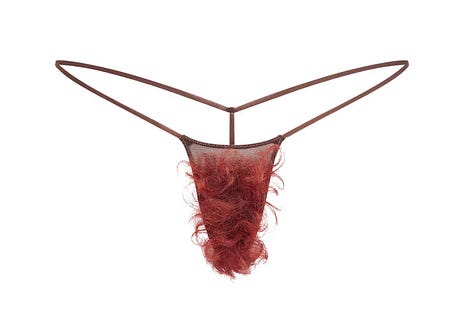
While the government was shut down and millions of us protested a wannabe dictator, our society quietly reached the apex of capitalism in a moment unsurprisingly brought to us by a Kardashian sister and not recognized by any economists. Kim Kardashian’s underwear and shapewear line Skims released a new G-string that has the hair on the outside. The faux hair micro string thong comes in 12 colors and has a combination of short, curly “hairs” and longer straighter ones. It retails for a mere $70 and sold out in hours. There’s now a waitlist.
Kim, who expertly turned her famous-for-being-famous status into multiple businesses, has publicly leaned into the hairless aesthetic. In one video clip circa 2022 she says, “Thank god I’ve laser hair removaled everything from my body so that I don’t have to like worry about Did I shave today? or anything like that.” And even though she’s already laser hair removaled it all, she appears in videos for an at-home laser hair removaler in which she uses or pretends to use the device. Now, after years of profiting from telling us to get rid of every last pube, she’s selling us fake ones. It’s a little diabolical, kind of genius, and clearly represents a capitalistic society that has stuck its head pretty far up its own ass. It makes sense that the OG reality family would be involved. There really is no better representation of the wealth disparity in this country than the Kardashians. Kim also made headlines last week for a Call Her Daddy podcast interview in which she revealed that she and Kanye once owned “like five Lamborghinis” (that he gave away during a mental health “episode”) and said she wished she knew how much milk cost. ($3-ish a gallon, but I only ever buy half-and-half.) Kardashian’s thoroughly modern merkin as a symbol of capitalism is ironic in ways she likely doesn’t understand. The original merkins were mostly worn by poor women who turned to sex work to survive. Merkins, or pubic hair wigs, are usually traced to an early syphilis epidemic that swept through Europe in the 1500s. Today’s syphilis infections cause sores on the genitals that can leave light scars, but it’s possible that the syphilis of the late Middle Ages was a tad worse. Italian physicians who treated soldiers during a 1495 battle with French troops said the enemy had pustules “more terrifying than leprosy and elephantiasis.” The infection got its name from Syphilis Sive Morbus Gallicus, a three-book series written in 1530 about a character who was cursed with a hideous disease after refusing to worship the god Apollo. In a 1998 book called The Great Pox, French historians write, “In some cases, the lips, nose or eyes were eaten away, or on others the whole of the sexual organs.” Merkins could hide some of that, and some were made with a lavender-scented powder that had the added benefit of covering up the smell of rotting flesh. (Eww.) These clever wigs were also used by women who’d had to shave their pubic hair because of pubic lice (also known as crabs). Because infestations were more common in people who had fewer resources (notably less access to a bath), shaving your pubes was a sign of being poor or unclean. Pretend pubic hair hid that fact which was particularly important to sex workers who needed to make money. The women could also use the wig as protection from getting pubic lice again because—unlike real pubic hair—it could be boiled between uses to kill the bastardly bugs. (Some suggest that merkins were used as a barrier for syphilis prevention too, but this seems less helpful because syphilis sores can appear anywhere in the genital area.) In an article for the British publication The Conversation, Esmé Louise James notes that “The merkin’s very existence is proof that women’s body hair has, for hundreds of years, doubled as a potent symbol of health, sexuality, fashion and autonomy.” Of course, whether you should have lots, some, or none has been a topic of ever-changing debate. The Egyptians removed their pubic hair and much of the other hair on their bodies with sharp flints and pumice stones. Women in ancient Turkey invented early depilatory creams. The Greeks plucked their short and curlies one by one because they thought public hair on women was uncivilized (and they didn’t even have a good Tweezerman to do it with). Flashing forward a few centuries or so, most women in the U.S. kept their post-puberty hair up until the first World War when Gillette introduced the My Lady Décolletée, the first razor marketed toward women. It was during World War II, however, that leg shaving became common because there was as shortage of nylon. Instead of hiding hair under stockings, women would shave. Some would then draw a seam up the back of their legs to mimic stockings. Shaving extended to the bikini area when the bikini itself was introduced in the mid-1940s. The pubic pendulum has swung back and forth many times since. The sexual revolution of the sixties and seventies embraced all things natural, which made the big bush popular. By the 1980s, however, we were wearing short shorts with the help of Nair. Pubic hair surface area seems to have shrunk from there. The take-it-all-off Brazilian—which removes all hair from the mons pubis and labia majora and waxes in the butt crack as well—was actually invented in New York City in 1987. It was pioneered at the J. Sisters Salon and got its name because the sisters themselves were from Brazil. Interestingly, despite being known for skimpy beachwear, women in their home country usually take off less than everything when they wax. (Fun fact: Elena, my waxer, who sees me at her house and charges next to nothing, got her start at the J. Sister Salon.) Brazilians made the mainstream in 2000 when Carrie Bradshaw went to LA, got waxed for the first time, and made “landing strip” a household phrase. (In case it never reached your household, it’s a style in which you leave a thin strip of pubic hair running down the center of the mons pubis while taking everything else off.) This was also around the time that internet porn became easier to access, and we realized that porn star pussies were hairless. This prompted a lot of discussion about the forces that made women (and only women since manscaping hadn’t hit the mainstream yet) want to reject their natural hairiness. In my sex educator circles, there were questions about what returning to a prepubescent state of smooth said about the women who waxed clean and their male partners who preferred it. Older colleagues feared it was a rejection of adult sexuality. Younger ones felt it was just a fashion statement. Over the next decade, researchers tried to understand these trends and the reasons behind them. One 2010 study surveyed 2,451 women and found that most women had some hair on their genitals, but it varied by age. While 20% of 18–24-year-olds and 12% of 25–29-year-olds said they were typically hair free in the previous month, only 2% of those 50 or older reported taking it all off. (If you’re trying to put this in current cultural or generational perspective remember that the study was published 15 years ago. Those 50-year-olds are now eligible for social security.) While some continued to argue that removing all your pubic hair was a symbol of unhealthy sexuality, this research told a different story. Those women who were typically or sometimes hair-free in the previous month scored significantly higher on their genital self-image scale. They had a more positive image of their own genitals than the women who had not waxed or shaved. This finding held true while controlling for other factors, though it doesn’t entirely explain the psychology behind waxing. It is possible that these women were already more comfortable with their vulvas before taking off the pubic hair, after all they splayed themselves in front of a stranger who approached with a pot of hot wax and a popsicle stick. Or it’s possible that they felt better about their genitals at the time of the study because they had “conformed” to a societal standard. Public health researchers also took note of the trends. One study found that ER visits for hair removal-related accidents increased fivefold between 2002 and 2010. Others suggested that we might be on our way to eradicating pubic lice by ridding our bodies of their natural habitat. (Don’t get excited, they’re making a comeback.) One study made headlines when it suggested that people without pubic hair were more likely to test positive for chlamydia and gonorrhea. The authors didn’t say this was a causal relationship, but that didn’t stop media outlets from declaring the protective benefits of pubic hair. (Don’t worry, another study a few years later found absolutely no bush-bacteria connection.) The only constant in fashion—whether we’re talking high-waisted jeans or blue eyeshadow—is that what was out will be in again and vice-versa. Gwyneth Paltrow (another symbol of capitalistic excess) was one of the first celebrities to sing the praises of being totally bare down there. In 1999, the actress called the Brazilian life changing, but by 2013 she admitted to rocking a 1970s vibe. That year, the New York Times announced that bush was back. It’s hard to know if the newspaper is correct because researchers seem to have lost interest in the topic around the same time. We do know, however, that Kim Kardashian has discussed her hairlessness in the years since then. Jessica DeFino, who writes the Flesh World, a Substack about the beauty industry, used to work for the Kardashian sisters creating content for apps they released in 2015 (she’s sorry). They did a piece on the pubic hair preferences of the sisters because of course they did. Khloe, who prefers to have some pubic hair, suggested that Kim regretted having hers laser removaled and wished “she had a little something going on.” On Instagram, DeFino quips that this may be this why Kim is offering to sell us all some pube wigs. I realize that the faux hair G-string is mostly a novelty item. Skims sells shapewear designed to smooth all rolls and wrinkles. People squeeze into that restrictive Lycra to appear sleek, and there’s nothing sleek about a gob of fake pubic hair that sits on the outside of your G-string. These seem to be designed for gag gifts, wedding showers, bragging rights, and a giggle with your partners or close friends. That’s cool. I’m not suggesting no one should buy them or even that Kim shouldn’t be selling them. But I am just saying that buying a furry G-string from an extremely wealthy woman who helped convince us to laser off our real hair feels like the ultimate pinnacle of late-stage capitalism and a perfect parody of it at the same time. It’s especially chilling coming at a moment when public health is being destroyed, the president (who also got his start on reality TV) is using his role to get as rich as he’s always pretended to be, and the East Wing of the White House is being bulldozed to make way for a wedding venue. Fake pubes didn’t bring us down, but they might be a sign of how far we’ve fallen. Sex on Wednesday is free today. But if you enjoyed this post, you can tell Sex on Wednesday that their writing is valuable by pledging a future subscription. You won't be charged unless they enable payments.
|
Thoroughly Modern Merkin






0 comments:
Post a Comment