Feeling So Gatsby For That Whole YearThe 2004 Election, Dick Cheney, and the Future of Gay Marriage
Remember when Dick Cheney was the face of an uncaring administration bent on increased executive power, more money for the already wealthy, and a foreign policy that at least bordered on war crimes? It practically seems quaint now. I mean he never threw a Gatsby-themed party complete with scantily clad ladies dancing in life-sized martini glasses while actively defying judges’ orders to feed hungry children. But Cheney, who died yesterday at 84, was the architect of many of the power-grabbing moves that have emboldened Donald Trump to act more and more like a dictator every day.
Cheney was behind the Patriot Act which expanded the government’s power of surveillance in the name of counterterrorism and was quickly abused. As the New York Times said in his obituary, “Later, it became clear that the Act was being used to underpin secret courts, wiretaps without warrants, the unlimited detention of suspects without hearings or charges, and interrogation methods that skirted bans on torture in the Geneva Conventions.” Sound familiar? In another move that would later portend Trump’s broad strategy of punishing his enemies, Cheney’s Chief of Staff Scooter Libby revealed the identity of an undercover agent to punish her journalist husband because he dared to question whether Iraq really had weapons of mass destruction. (Spoiler alert: it didn’t.) Cheney was never officially implicated in that scandal, though many assumed he was the power behind it. Libby was convicted and sentenced to 30 months in prison, but Bush commuted his prison time.
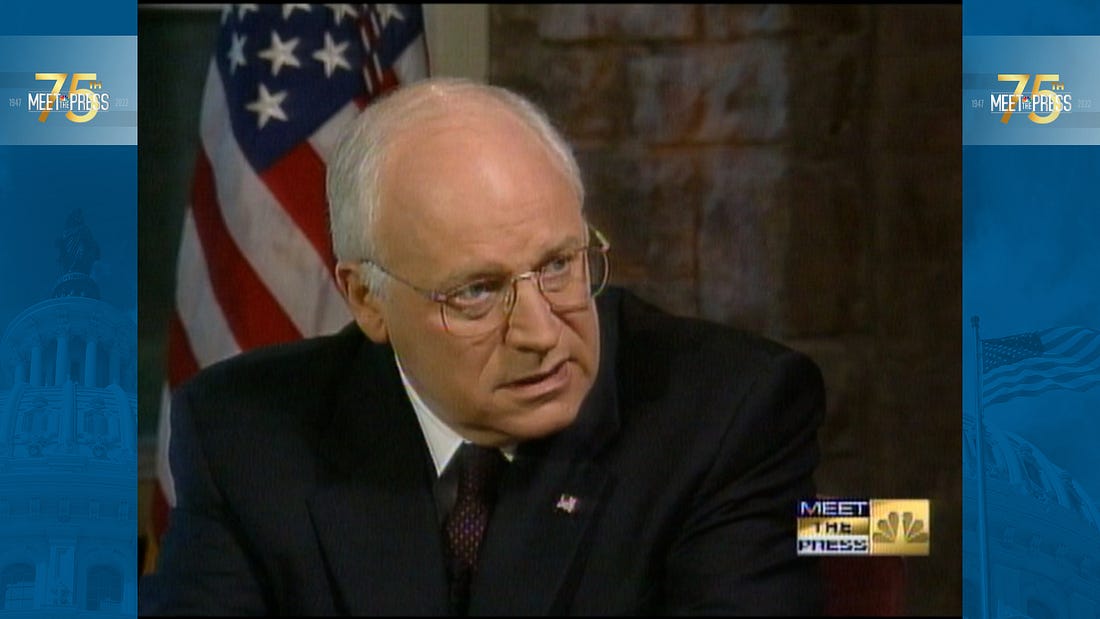
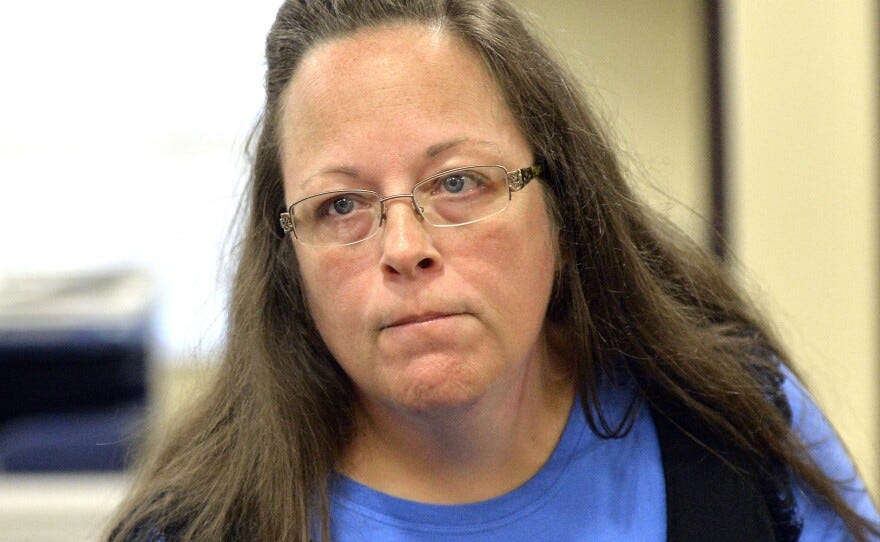
What cemented my vision of Dick Cheney as an uncaring bastard was an interview he gave about the morning of 9/11. I don’t remember whether this was given a few weeks or a few years after the terrorist attack, but I will never forget what he said about the decision to shoot down a plane if necessary. United Airlines flight 93 was still in the air after two planes hit the twin towers and one struck the Pentagon. Ultimately, passengers took down the hijackers, and the plane crashed in a field in Pennsylvania. But there was a time when it looked like the government might shoot the plane out of the sky instead. We later found out that Cheney authorized the military to do so. (It’s not clear who/what authorized him to authorize, given that he wasn’t the president and that the president wasn’t dead or even incommunicado, he just wasn’t in the building.) In the interview that I’m remembering, the reporter asked Cheney if ordering a plane full of Americans to be shot down was a difficult decision. He said, “No.” No. I get it. People in power have to make difficult decisions all the time, and we want them to be disciplined and decisive. But we also want them to be human. No is not a human answer. The human answer—and the one that any media trainer anywhere would insist that even their most cold hearted clients give—goes like this: “Of course. It was one of the most difficult decisions I’ve ever had to make. Anytime you make a decision that might cost people their lives, it’s terrible, but sometimes you have to make truly difficult decisions to protect more lives. The hero passengers on the plane understood that, and we will always be grateful for the sacrifices they made.” That’s what he should have said, because that’s what a human says. But he just said no. In truth, the only time Cheney demonstrated any humanity was when he was talking about gay marriage, and it took him a while to get there. His younger daughter Mary is a lesbian. When he first hit the campaign trail with George W. Bush in 2000, Cheney and his wife were cagey about Mary’s sexuality. They spoke more publicly about it during the 2004 re-election campaign when same-sex marriage was the wedge issue du jour. (Thanks Karl Rove.) George W. Bush was running on a platform that included passing a constitutional amendment to ban gay marriage. As his running mate, Cheney tried to avoid the issue as much as possible. But when pushed he admitted that he disagreed with the President. At a campaign event in Mississippi Cheney said, “Lynn and I have a gay daughter, so it’s an issue our family is very familiar with. With respect to the question of relationships, my general view is freedom means freedom for everyone.… People ought to be free to enter into any kind of relationship they want to.” Mary, who served as his director of vice-presidential operations during that campaign, was in the audience. Don’t get me wrong, Dick was never a champion of gay rights. Despite those strong words for the time, he said he wanted to leave decisions up to the states, many of which were actively trying to stop people from entering into relationships of their choice. He was, however, a champion of his daughter. In 2012, when Mary married her long-time partner Heather, the Cheney’s put out a statement of support that read in part, “Mary and Heather have been in a committed relationship for many years, and we are delighted that they were able to take advantage of the opportunity to have that relationship recognized. Mary and Heather and their children are very important and much-loved members of our family and we wish them every happiness.” Mary and Heather’s relationship was recognized because they lived in Washington, DC where same-sex marriage became legal in 2009. It would be a few more years before the Supreme Court’s decision in Obergefell v. Hodges effectively made gay marriage legal everywhere. Unfortunately, that decision could be revisited soon. On Friday, SCOTUS is set to consider whether to hear a case challenging it. The case was brought by Kim Davis. Remember her? She’s the county clerk in Kentucky who was jailed for refusing to issue marriage licenses to same-sex couple.
Davis was sued by one of the couples she rejected, and a jury awarded them $100,000 in damages. She appealed arguing that she couldn’t be held liable because issuing the marriage license would have violated her First Amendment right to freely exercise her religion. The 6th Circuit Court of Appeals disagreed. It said she wasn’t a private citizen when she refused to issue the license but an agent of the government which meant her actions were not protected by the First Amendment in the same way. Davis appealed to the Supreme Court this summer. This time she is arguing that it isn’t fair for her to be treated as a government official when it comes to issues of her First Amendment rights but as a private citizen when it comes to tort liability. Her ask of the high court, however, goes beyond her own case. She wants the court to overrule its decision in Obergefell because—as she sees it—the right to same-sex marriage has no basis in the Constitution and forces people like her to choose between their religious beliefs and their jobs. This is bulls**t because Kentucky passed a law in 2016 that made it possible for clerks like Davis to hand off same-sex marriage license to their deputies and even take their names off of the forms. But this is just the kind of bulls**t that our current Supreme Court laps up. It is religious freedom defined not as my right to freely practice what I believe but as your right to impose your religious beliefs on me. Like our President who also espouses this backwards doctrine of religious freedom that sees Christians as the most—if not only—persecuted group, Davis has been married multiple times. She had an affair while married to her second husband and got pregnant with twins. She got divorced and married the twins’ father. She later divorced him and remarried her second husband. So, she’s been married four time to three different men. But hey, the important thing is that they were all men. There’s something truly ridiculous about the fact that Kim Davis is the reason that this issue might be reopened. In order for the decision to be overturned someone would have to convince the court that the legalization of same-sex marriages put an unconstitutional burden on them. That’s not easy because most of us have figured out that other people’s marriages are at most none of our business. But as Charlotte Clymer points out, “… Ms. Davis can lay claim to being the only person in America whom can, in theory, assert that she’s been burdened by Obergefell because of the legal fees she’s been ordered to pay (along with the jail time, emotional burden, etc).” It’s pretty flimsy, but we’re dealing with a Supreme Court that is looking for excuses to revisit cases and rights that each of them promised were solid precedent during their confirmation hearings. In his concurrent opinion for Dobbs, Clarence Thomas wrote that the Court should keep going and look at cases like Griswold v. Connecticut (the right to use contraception), Lawrence v. Texas (the right to have anal or oral sex), and Obergefell v. Hodges. The court could refuse to hear the case after meeting on Friday or it could think about it a little more. Some experts say it’s unlikely they’ll hear the case, but it’s hard to have any faith in this court to do the right thing. To bring this all full circle, a 2020 article in the University of Arkansas Law Review suggests that the focus on gay marriage during the 2004 election could be blamed for the current make up of the Supreme Court. Rutgers Law Professor Earl M. Maltz notes that same-sex marriage became the wedge issue of the election because of a decision the year before by the Massachusetts Supreme Court which found the state constitution required the government to recognize same-sex marriage. This judicial decision outpaced politics and public opinion and put the issue in the spotlight. What followed was a concerted effort by Republicans to use gay marriage and the general fear of activist judges to win the presidential election. (Thanks Karl Rove.) Not only did Bush support a federal constitutional amendment banning gay marriage, but many states also put such an amendment on their ballots. As much as anything, this was a voter turn-out strategy; get them to the polls with homophobia and they’ll re-elect Bush and Cheney in a walk. It didn’t help that the Democrats were decidedly tepid on the issue. Kerry and Edwards both said they opposed gay marriage but wanted to make sure same-sex couples had equal(ish) rights. Maltz argues that the Republican strategy worked. The election was very close and ultimately came down to a slim margin in Ohio, one of the states with a gay marriage amendment on the ballot. There’s a way of looking at it that a small number of conservative voters in Ohio handed Bush his second term and that they may have been motivated by this very issue. (To be fair, other experts have argued that the election results were not sufficiently impacted by the gay-marriage issue.) Maltz goes on to remind us that the election of 2004 had a significant impact on the future of the Supreme Court because the following year Sandra Day O’Connor would retire for personal reasons and Chief Justice William Rehnquist would die. That not only gave us John Roberts and Samuel Alito, but also decisions like Citizens United that reshaped future elections. Had John Kerry won in 2004 and put a liberal justice in just one of those seats, the court would look very different which would have ripple effects in our lives and our politics. (This is a depressing game we can play with the outcome of every election or the timing of every death. I find myself imagining a court with Merrick Garland and a timeline where RBG lived for just a few more months quite frequently.) The changing court didn’t have an immediate impact on the issue of same-sex marriage. There were still enough liberal justices in 2015 to eek out a 5-4 decision in Obergefell that declared all of those amendments outlawing same-sex marriage to be unconstitutional. But Alito and Roberts have since been joined by Kavanaugh, Gorsuch, and Barrett, and they’ve all started unsettling settled law. Given the possible significance of the 2004 election on the court and his strange relationship with the gay marriage debate, it would make some weird universe-bending-in-on-itself sense if SCOTUS decided to re-open this particular case in the days following Dick Cheney’s death. During last year’s election, Cheney—whose older daughter Liz had been a member of the House and a frequent target of Trump—announced he was voting for Kamala Harris. “We have a duty to put country above partisanship to defend our Constitution,” Cheney said. Too little, too late, especially coming from the guy who set the stage for a too-powerful executive with little regard for who might fill that role some day. I first learned of his death yesterday from a friend’s Facebook post which said, “Dick Cheney has died. Que Dios le perdone.” That translates to “may god forgive him.” Okay, sure, but we don’t have to. ** Postscript: In another full circle moment, Dick Cheney died on an election day that has been described by some as a blue tsunami. Democrats won big in states like mine, and California voters helped make sure Trump can’t rig the midterms. In many of last night’s races Republicans tried to use the 2004 playbook and make transgender people and their basic human rights the boogieman that got conservative voters to the polls. Guess what Dick? This time it didn’t work. Poetic justice? Karma? Take your pick. We did good last night. Sex on Wednesday is free today. But if you enjoyed this post, you can tell Sex on Wednesday that their writing is valuable by pledging a future subscription. You won't be charged unless they enable payments.
|
Feeling So Gatsby For That Whole Year







0 comments:
Post a Comment